Overview
To enable long-exposure astrophotography with my Nikon D3300, I designed and built an automated equatorial mount that tracks the stars by rotating at 15° per hour. Instead of purchasing commercial solutions costing nearly $1000, I engineered my own cost-effective and customizable system.
Problem
Long-exposure astrophotography requires precise tracking to prevent star trails caused by Earth’s rotation. Without an equatorial mount, the camera cannot remain fixed on a celestial object, limiting the exposure time and light capture.
Implementation
Step 1: Research & Design
By aligning the mount’s rotation axis with Polaris, which remains nearly stationary in the night sky, I could track celestial objects at 15° per hour. I opted for a NEMA17 stepper motor, but with a standard 1.8° step size, direct drive would be too imprecise and fast. To slow it down and increase precision, I incorporated an 8:1 gear ratio using pulley belts instead of 3D-printed gears to minimize backlash.
Step 2: Mechanical Engineering Challenges
The camera’s weight required sufficient torque, which the gear ratio helped address. Additionally, I incorporated counterweights for balance and altitude/azimuth adjustments for precise alignment. I also had to source appropriate bolts, including a standard tripod mount screw, to secure the camera.
Step 3: Electronics & Control
The stepper motor was controlled via a simple driver circuit housed in a control box, powered by a portable power bank. Since the motor’s current draw was minimal due to its slow operation, this solution provided portability without requiring heavy batteries.
Results
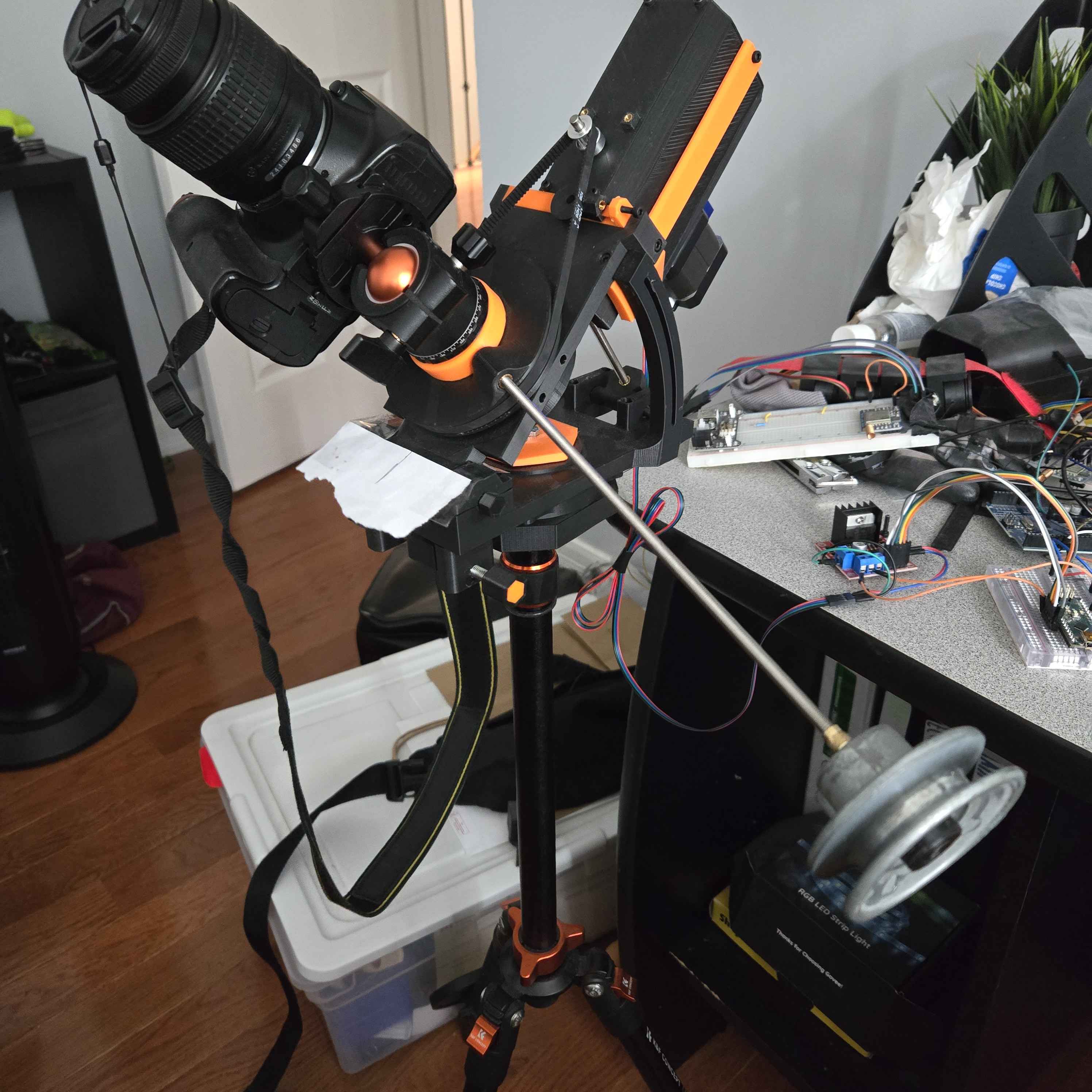
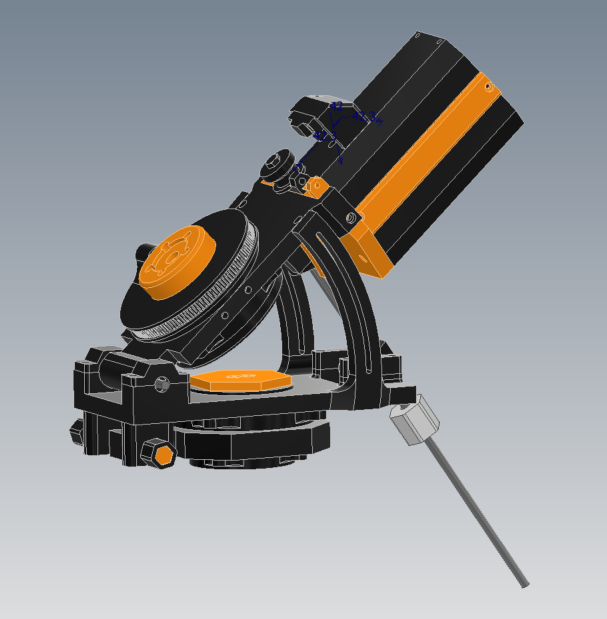
The final equatorial mount successfully tracked celestial objects, allowing for longer exposure times without star trails. This project deepened my understanding of stepper motor control, mechanical tolerances in 3D-printed components, and astrophotography techniques.